
Meta Muse Glimmer: The Big AI Story Today
The artificial intelligence industry is entering another important phase.
For years, the AI race largely focused on building increasingly powerful models and serving them from massive data centers. Now, the competition is expanding toward another question:
How much capable AI can run closer to the user?
Meta is putting that question at the center of its latest AI strategy with Muse Glimmer, a new open-weight model designed for agentic workloads and consumer-grade hardware.
The announcement is significant because Meta is not simply competing on benchmark scores. It is pushing a broader idea: capable AI should be accessible to developers and users without necessarily requiring every task to be processed by a centralized cloud service.
At the same time, Alibaba is pushing forward with its Qwen family, including Qwen3.8-Max, creating a rapidly expanding open-weight AI landscape.
What Is Meta Muse Glimmer?
Muse Glimmer is a compact, open-weight AI model from Meta designed to perform complex reasoning and agentic tasks.
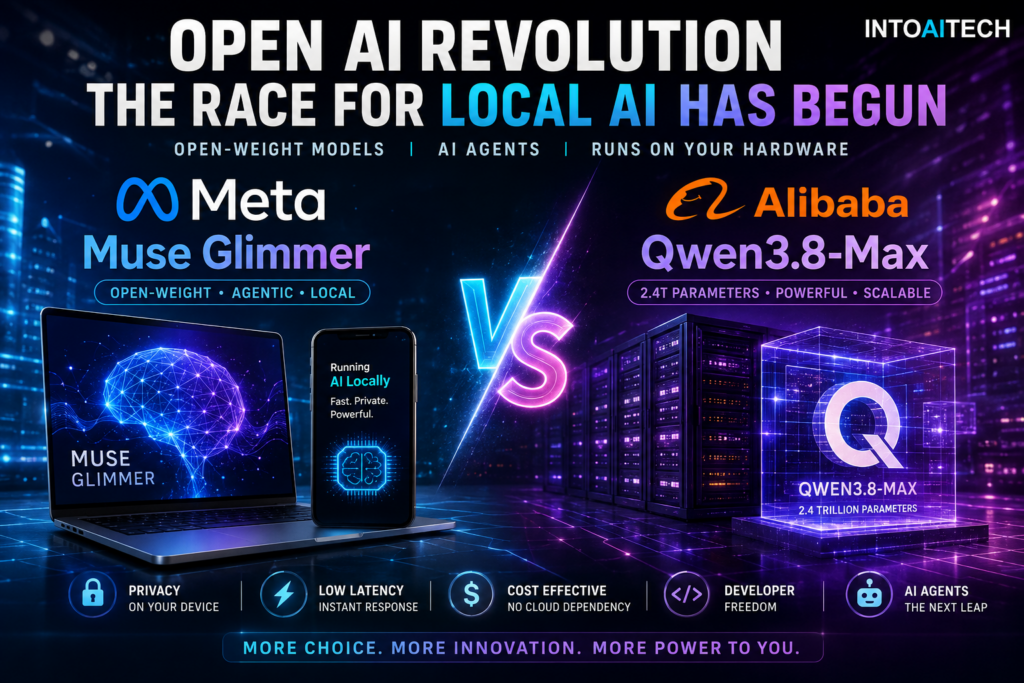
According to reports surrounding the launch, Glimmer is intended to run on consumer-grade computers rather than requiring the enormous infrastructure normally associated with frontier AI models. It was developed using distillation techniques from Meta’s larger Muse models. (Business Insider)
That distinction is important.
A traditional cloud AI system requires users to send requests to remote servers. A capable local model can potentially perform at least some tasks directly on a user’s computer.
That can provide several potential advantages:
- Lower latency
- Greater control over data
- Reduced dependence on cloud APIs
- Potentially lower operating costs
- Offline or partially offline AI capabilities
- More flexibility for developers
However, local AI does not automatically mean every workload can be performed locally. Larger models and demanding workloads can still require substantial computing resources.
Muse Glimmer vs Cloud AI: Why Local Models Matter
Cloud AI remains extremely powerful.
Services from companies such as OpenAI, Google and Anthropic can provide access to very large models without requiring users to purchase expensive GPUs.
But local models have a different advantage: control.
Imagine a developer building an AI assistant that processes sensitive documents.
With a cloud-based system, documents may need to leave the user’s device and be processed remotely, depending on the service architecture and privacy settings.
With a sufficiently capable local model, some processing could happen directly on the device.
That could be particularly useful for:
- Enterprise applications
- Developers
- Cybersecurity tools
- Personal assistants
- Document processing
- Private coding environments
- Offline applications
- Edge devices
The challenge is hardware.
Running a model locally requires enough memory, compute capacity and software optimization. The smaller and more efficient the model, the more practical local deployment becomes.
That is why compact agentic models could become strategically important.
The Qwen3.8-Max Factor
Meta is not alone in pushing open-weight AI.
Alibaba’s Qwen3.8-Max has become another major development in the rapidly changing AI model landscape.
Alibaba introduced Qwen3.8-Max as a large-scale model with a reported 2.4 trillion parameters, positioning it as one of the company’s most capable AI systems. The model has been presented as a major competitor to leading frontier systems.
What Could Local AI Mean for Smartphones?
The next major battleground could be smartphones.
Modern smartphones already contain dedicated AI processing hardware. Android is also continuing to add capabilities aimed at productivity, security and AI-assisted experiences. Google has highlighted new Android features around productivity, gaming and security in Android 17. (blog.google)
As models become smaller and more efficient, some AI tasks could increasingly move directly onto smartphones.
That could enable features such as:
- Private on-device assistants
- Real-time translation
- Offline summarization
- AI photo editing
- Personal document search
- Smart notifications
- Voice assistants with lower latency
- AI-powered gaming features
The biggest limitation remains computational resources.
A smartphone cannot simply run a massive data-center model unchanged. Models must be optimized, compressed or distilled.
That makes smaller models such as Muse Glimmer particularly interesting for the future of edge AI.
Final Verdict
Meta Muse Glimmer is important not because it immediately replaces the biggest AI models, but because it represents where the AI industry may be heading next: capable models that are smaller, more accessible and increasingly able to operate closer to users.
The simultaneous growth of Meta’s Muse ecosystem and Alibaba’s Qwen family shows that the AI competition is expanding beyond proprietary cloud models.
The next major AI battle may not simply be: