
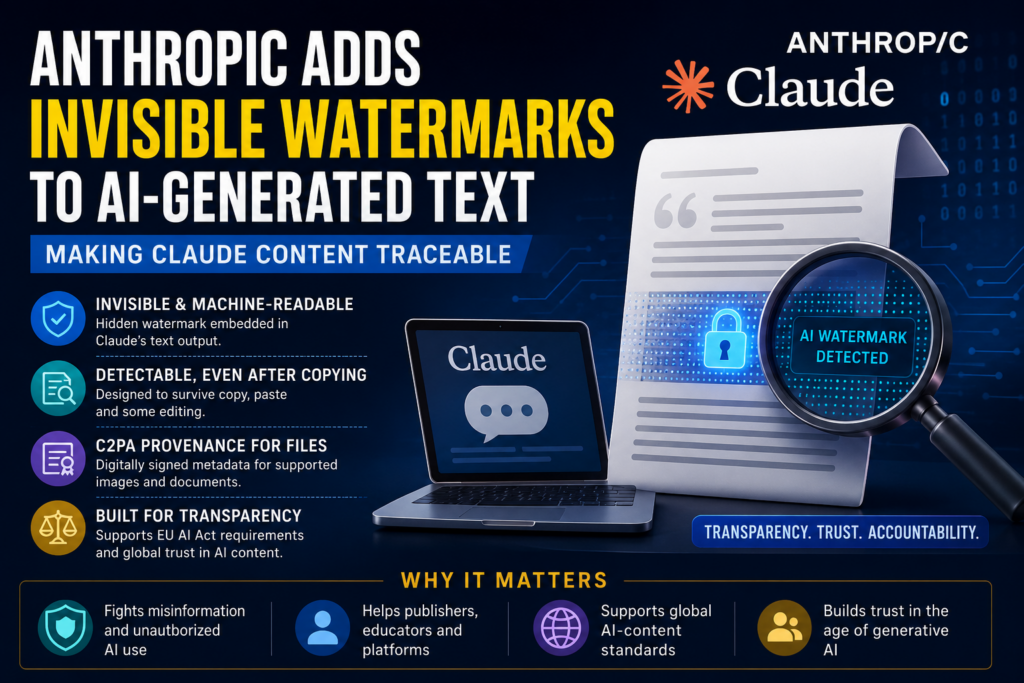
Anthropic Is Making Claude-Generated Text Traceable
Artificial intelligence has made it increasingly difficult to determine whether a piece of writing was produced by a person or an AI system.
That problem is becoming more important as AI-generated content spreads across journalism, education, marketing, software development and social media.
Anthropic, the company behind Claude, is now taking a significant step toward solving part of that problem.
The company has announced that new Claude models will include an imperceptible, machine-readable watermark in generated text. Anthropic is also adding digitally signed provenance information to supported generated files using the C2PA standard.
The goal is straightforward:
Make AI-generated content identifiable without placing a visible label on the content itself.
What Is an Invisible AI Watermark?
An invisible watermark is a signal embedded into content that cannot normally be seen by a person but can potentially be detected by specialized software.
For text-generation systems, the watermark can be incorporated at the model level during generation.
Instead of adding something obvious such as:
“Generated by Claude”
the system can subtly influence the statistical choices made while generating text.
The resulting article, email or code can look completely normal to the user.
However, a specialized detection system may be able to identify a statistical pattern associated with Claude.
Anthropic has not publicly disclosed all of the technical details of its watermarking method, so claims about exactly how the watermark works should be treated cautiously. Reporting indicates that the watermark is designed to survive common actions such as copying and pasting and some limited editing.
When Did Anthropic Start Watermarking Claude Text?
Anthropic’s new approach applies to Claude models released on or after August 2, 2026, according to reporting on the company’s announcement.
Anthropic is also working on extending the technology to older models.
This distinction matters.
It would be inaccurate to assume that every piece of text ever generated by Claude now contains the watermark.
The technology is being introduced as part of Anthropic’s newer model-generation strategy.
Why Is Anthropic Adding Watermarks?
The main reason is AI-content transparency.
The European Union’s AI Act includes transparency requirements for AI-generated or manipulated content. The relevant requirements are becoming applicable in August 2026.
Anthropic has therefore chosen to introduce content provenance technology as part of its compliance strategy.
However, the company is reportedly applying the watermarking approach globally rather than limiting it exclusively to European users.
That makes the announcement much more significant than a simple regional compliance update.
Claude users outside Europe may also encounter the technology.
Does Copying and Pasting Remove the Watermark?
Anthropic’s system is designed to make the watermark more resilient than simple metadata.
Reports indicate that the text watermark can persist through common operations such as copying and pasting, and potentially some minor editing.
That is important because conventional metadata can easily disappear.
For example, if an image contains metadata identifying its creator, uploading it to another service may strip that information.
A watermark embedded directly into the content is fundamentally different.
However, this does not mean the watermark is impossible to remove.
Heavy rewriting, translation, extensive editing or mixing AI-generated text with human-written material could potentially reduce or eliminate the detectable signal. Anthropic has acknowledged limitations around these systems.
Why AI Watermarking Matters for Publishers
Publishers are facing a growing challenge.
AI can generate articles, product descriptions, summaries, marketing copy and other written material at enormous scale.
That creates a fundamental question:
How can a publisher determine whether submitted content was generated by AI?
A watermark could provide another signal.
For example, a publisher receiving an article could potentially check whether it contains a Claude watermark.
That could be useful for:
- Editorial workflows
- Content verification
- AI disclosure
- Investigations into undisclosed AI use
- Digital publishing
- Academic integrity
However, watermark detection should not automatically be treated as proof that a human did not contribute to the content.
Someone could use Claude for brainstorming, editing or rewriting while doing most of the original work themselves.
This creates an important distinction between:
AI-assisted content and fully AI-generated content.
What About Students and Education?
Education is another area where AI provenance could have a major impact.
Schools and universities increasingly face questions about whether assignments were written by students or generated using AI.
A reliable watermark could potentially provide another piece of evidence.
But it should not become a standalone “AI cheating detector.”
Why?
Because watermarking has limitations.
A student could:
- Rewrite AI-generated material
- Translate it
- Combine it with human writing
- Use another AI system
- Make substantial manual changes
Conversely, false positives and detection uncertainty can create problems if institutions treat an AI signal as conclusive proof of misconduct.
The safest approach is therefore to treat watermarking as one signal among several, not an automatic verdict.
Will Claude Watermarks Affect AI-Generated Code?
This is potentially one of the most interesting questions for developers.
Claude is widely used for programming through products such as Claude Code and its API.
If model-generated code contains a detectable watermark, organizations could potentially investigate whether a codebase contains AI-generated material.
That could matter for:
- Software audits
- Enterprise governance
- Copyright investigations
- Internal development policies
- AI-use disclosure
- Code provenance
However, code is fundamentally different from ordinary prose.
Developers frequently combine AI-generated code with existing code, manually modify it and run it through formatting and compilation tools.
That could make reliable attribution much more difficult.
Therefore, it would be premature to describe Claude watermarking as a perfect AI-code detector.
Final Verdict
Anthropic’s decision to embed invisible watermarks into Claude-generated text marks an important shift in the AI industry.
Until now, much of the discussion around generative AI focused on what AI can create.
The next phase is increasingly about where that content came from.
Invisible watermarks, C2PA metadata and other provenance technologies could become an important part of the digital ecosystem as AI-generated content becomes harder to distinguish from human work.
But watermarking is not a magic solution.
Its effectiveness will depend on detection accuracy, resistance to manipulation, independent verification and adoption across the wider AI industry.
The most important development may therefore not be Anthropic’s watermark alone.
It may be the emergence of a broader internet standard in which AI-generated content carries verifiable information about its origin.
If Google, OpenAI, Meta, Microsoft and other major AI companies adopt compatible approaches, AI provenance could eventually become a normal part of publishing, software development, education and online media.
The AI era is entering a new stage: creating content is no longer enough. Proving where that content came from may become just as important.