
Tencent’s Hy4 Takes the Open-Source AI Race to Another Level
The race to build powerful open AI models is getting increasingly competitive.
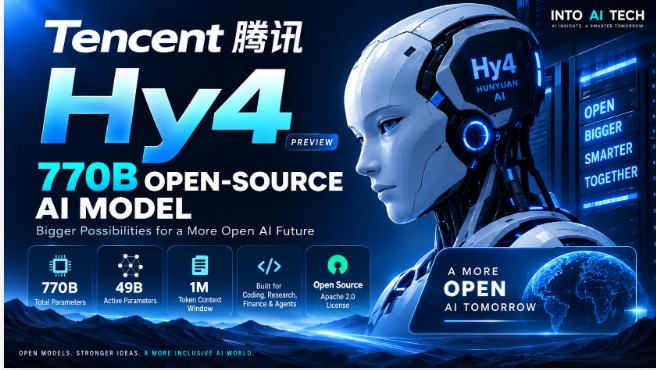
Tencent has now entered the latest round with Hy4 preview, a new model from its Hunyuan AI team that combines a huge 770-billion-parameter architecture with a relatively small 49-billion active parameter footprint for each token.
The model was released on August 28 and is available through platforms including Hugging Face, ModelScope, GitCode and CNB. Tencent is also making Hy4 available through its own products and APIs.
What makes the release particularly interesting isn’t simply the 770B headline.
Hy4 uses a Mixture-of-Experts (MoE) architecture, meaning it does not activate the entire model for every request. Instead, only a portion of its parameters are used for each token.
That allows Tencent to build a model with enormous overall capacity while limiting the amount of computation required for each individual token.
And there is another major number to watch:
1 million tokens of context.
That puts Hy4 firmly into the growing competition around AI systems capable of processing extremely large amounts of information in a single task.
What Is Tencent Hy4?
Tencent Hy4 preview is the latest flagship model from Tencent’s Hunyuan AI team.
According to Tencent’s official model documentation, Hy4 has:
- 770 billion total parameters
- 49 billion activated parameters per token
- 1 million-token context window
- 78 layers
- 256 routed experts
- 1 shared expert
- Mixture-of-Experts architecture
- Gated DeepSeek Sparse Attention
- Support for reasoning, coding and agentic workloads
The model is released under the Apache 2.0 license, according to its official Hugging Face repository.
That licensing detail is important for developers because it provides considerably more freedom than many restrictive AI-model licenses, although organizations should still review the applicable license and deployment requirements for their particular use case.
Why 770 Billion Parameters Doesn’t Mean 770 Billion Parameters Run Every Time
The biggest headline surrounding Hy4 is its 770 billion parameters.
But that number needs some explanation.
Hy4 uses a Mixture-of-Experts architecture.
Instead of activating every parameter for every request, the model routes each token through selected expert networks.
Tencent’s documentation says Hy4 has 256 routed experts plus one shared expert, with eight routed experts activated for each token alongside the shared expert.
That means the model can maintain a very large total parameter capacity without performing the equivalent computation of a dense 770B model on every token.
In simple terms:
Total parameters = the model’s overall capacity
Active parameters = the portion used for a particular token
This distinction is important when comparing Hy4 with other AI models.
A 770B MoE model should not automatically be considered equivalent to a dense 770B model.
The 1 Million-Token Context Window Could Be a Major Advantage
Another major feature of Hy4 is its 1 million-token context window.
A context window determines how much information an AI model can process within a single interaction.
A very large context window can be particularly useful for:
- Large software repositories
- Long technical documents
- Research papers
- Financial records
- Multiple business documents
- Large datasets
- Complex project specifications
- Long-running AI-agent tasks
Tencent’s cloud documentation lists Hy4 with a 1M-token context window, while its API documentation specifies up to 960,000 input tokens and 64,000 output tokens.
For developers, this could make Hy4 particularly interesting for tasks where information is spread across many files or documents.
Tencent Is Designing Hy4 for Real-World Work
Tencent isn’t positioning Hy4 simply as a chatbot.
The company says it worked with experts from different internal departments—including software engineering, game development, finance and security—to create training data around real-world tasks.
Tencent highlights four major areas.
1. Software Engineering
Hy4 is designed to understand longer development tasks involving:
- Requirements
- Planning
- Coding
- Debugging
- Verification
- Front-end development
This reflects a broader change in AI coding.
The industry is moving away from simple code autocomplete toward AI systems capable of handling entire development workflows.
2. Office and Financial Analysis
Tencent says Hy4 can process information distributed across multiple files and turn it into useful outputs such as:
- Documents
- Spreadsheets
- Presentations
- Data analysis
- Financial models
This is an important direction because enterprise AI increasingly needs to work with messy, unstructured business information rather than isolated prompts.
3. Game Development
Tencent also says Hy4 can assist with game development and interact with game engines.
The company describes a workflow where developers can start with a natural-language requirement and work toward a playable prototype.
If these capabilities translate well outside Tencent’s internal environment, AI-assisted game development could become another significant application for large open models.
4. Scientific Research
Tencent says Hy4 has been developed for scientific and mathematical workloads, including areas such as:
- Molecular dynamics
- Condensed matter physics
- Mathematics
- AI research
This reflects a much broader trend in the AI industry.
Large language models are increasingly being tested not just as assistants but as research tools capable of reasoning through technical problems.
Tencent’s Internal Testing Shows Promising Results
Tencent conducted an internal blind evaluation involving 163 experts and 203 engineering tasks.
According to Tencent’s published results, Hy4 achieved an average score of 2.99 out of 4, compared with:
- GLM 5.3: 2.92
- Kimi K3: 2.94
Tencent also reported that Hy4 had more wins than losses against both comparison models in the evaluation.
However, these results should be interpreted carefully.
They are Tencent’s internal evaluation results, not an independent industry-wide benchmark.
That means they demonstrate how Tencent says the model performed under its testing methodology, but they do not by themselves prove that Hy4 is universally better than GLM 5.3, Kimi K3 or other leading AI models.
Independent testing will be important.
Hy4 Is Not a Finished Model
One of the more useful aspects of Tencent’s release is that the company openly identifies limitations.
Tencent says Hy4 preview can sometimes:
- Spend too long reasoning about difficult tasks
- Over-verify its own answers
- Take longer than necessary on complex problems
The company describes the release as an early version that will continue to be improved.
This is important for businesses considering the model.
A model’s benchmark score is only one part of the equation.
In real-world AI applications, latency, reliability, cost and consistency can be just as important.
A model that produces a slightly better answer but takes substantially longer to complete a task may not always be the better option for an enterprise workflow.
Where Can Developers Access Hy4?
Tencent has made Hy4 available through several channels.
The official model documentation lists:
- Hugging Face
- ModelScope
- GitCode
- CNB
Tencent has also integrated Hy4 with products including:
- WorkBuddy
- CodeBuddy
- Yuanbao
- ima
API access is available through Tencent Cloud TokenHub and OpenRouter.
Tencent also announced free access to Hy4 through WorkBuddy and CodeBuddy for two weeks after launch, while free access to the previous Hy3 model was extended through September 30.
For developers who don’t want to operate the model themselves, hosted access can therefore be considerably easier than deploying the full model infrastructure.
Can You Run Hy4 Locally?
Technically, the model is designed for self-hosted deployment using frameworks such as vLLM and SGLang, according to the official model documentation.
But “open-source” should not be confused with “easy to run on a normal laptop.”
A 770B-parameter model is extremely demanding.
Even though only 49B parameters are active per token, the complete model still represents a very large computational and memory requirement.
For most individual users, hosted inference will be significantly more practical.
The open release is particularly valuable to:
- AI researchers
- Cloud providers
- Enterprise AI teams
- Model developers
- Universities
- AI infrastructure companies
- Developers with access to substantial GPU resources
Why Hy4 Matters for the Global AI Race
Tencent’s release arrives at an important moment.
Open-weight AI models are becoming increasingly capable.
Companies such as Alibaba, DeepSeek, Meta, NVIDIA and others are pursuing different strategies around open models.
Tencent’s Hy4 adds another major competitor.
The important change is that the competition is no longer only about parameter counts.
Developers increasingly care about:
Capability
Inference efficiency
Context length
Licensing
Tool use
Agent performance
Coding ability
Real-world reliability
This makes Hy4’s combination of a huge MoE architecture, long context and Apache 2.0 licensing particularly noteworthy.
Hy4 and the Rise of AI Agents
One of the most important areas for Hy4 is agentic AI.
Traditional AI models generally respond to a prompt.
An AI agent can potentially:
- Understand a goal.
- Break the goal into steps.
- Use tools.
- Read information.
- Write or modify files.
- Execute tasks.
- Check the results.
- Continue working.
Tencent’s own cloud documentation positions Hy4 for agent, coding and productivity scenarios, with capabilities including reasoning and tool calling.
This is important because the AI industry is moving toward systems that can perform longer sequences of work.
A large context window can be particularly useful for such systems because agents may need to maintain information about an ongoing task across many steps.
The Bigger Story: Open AI Is Becoming More Competitive
Hy4 is not important simply because Tencent has released a 770B model.
The bigger story is what the release says about the direction of AI.
Large technology companies are increasingly willing to release powerful model weights rather than keeping every advanced capability behind a closed API.
That gives developers more choices.
Instead of relying entirely on a single provider, companies can potentially build hybrid AI architectures using:
- Closed frontier models
- Open-weight models
- Smaller local models
- Specialized AI models
- Cloud inference
- Private infrastructure
This could make the AI ecosystem more competitive.
What Could Hy4 Mean for Businesses?
For businesses, the biggest potential benefit isn’t necessarily having access to a giant model.
It is control.
Organizations using an open model can potentially customize deployment, integrate it into existing infrastructure and build specialized workflows around it.
That can be particularly useful in areas where businesses have large amounts of proprietary information.
Examples include:
Software companies
Use Hy4 for code analysis, development assistance and testing.
Financial organizations
Use it for document analysis and financial workflows, subject to appropriate security and compliance controls.
Research organizations
Process large technical documents and assist researchers with complex information.
Enterprises
Build AI agents that work across internal documents and business applications.
However, organizations should independently evaluate security, privacy, infrastructure requirements and licensing before deploying any AI model in production.
What About OpenAI, Anthropic and Other Closed Models?
Hy4 doesn’t necessarily replace closed frontier models.
Closed models still have major advantages:
- Managed infrastructure
- Easy deployment
- Rapid updates
- Enterprise support
- Strong general-purpose performance
- No requirement to operate large GPU clusters
Open models offer a different set of advantages:
- More deployment control
- Greater customization
- Potentially easier private deployment
- More flexibility for developers
- Ability to inspect and modify the model ecosystem
The likely future is not open versus closed.
It is a combination of both.
What We Need to Watch Next
Hy4 is still a preview, so several questions remain unanswered.
Independent benchmarks
How will Hy4 perform when independent researchers compare it with competing models under identical conditions?
Real-world inference cost
How much does it actually cost to operate Hy4 at scale?
Agent reliability
Can it complete long-running tasks consistently without excessive reasoning or repeated verification?
Coding performance
Will developers find it competitive with the best coding-focused models?
Long-context performance
Does the 1-million-token context window translate into meaningful advantages on real workloads?
Developer adoption
Will companies actually build products around Hy4?
These questions will determine whether Hy4 becomes a major open-model ecosystem or simply another impressive model release.
Final Verdict: Tencent Is Making the Open AI Race More Interesting
Tencent Hy4 preview is one of the most significant open-model releases of August 2026.
Its 770-billion-parameter MoE architecture, 49-billion active parameters, 1-million-token context window and Apache 2.0 licensing make it an interesting option for researchers and developers looking for a powerful open model.
But the most important part of Hy4 may not be its enormous parameter count.
Tencent is betting that AI models should be designed around real work.