
The AI model race is entering a new phase. Instead of competing only on chat quality, coding benchmarks or image generation, leading AI companies are increasingly focused on autonomous agents, cybersecurity, scientific research and the ability to complete complex multi-step tasks.
Two major developments announced this week illustrate that shift.
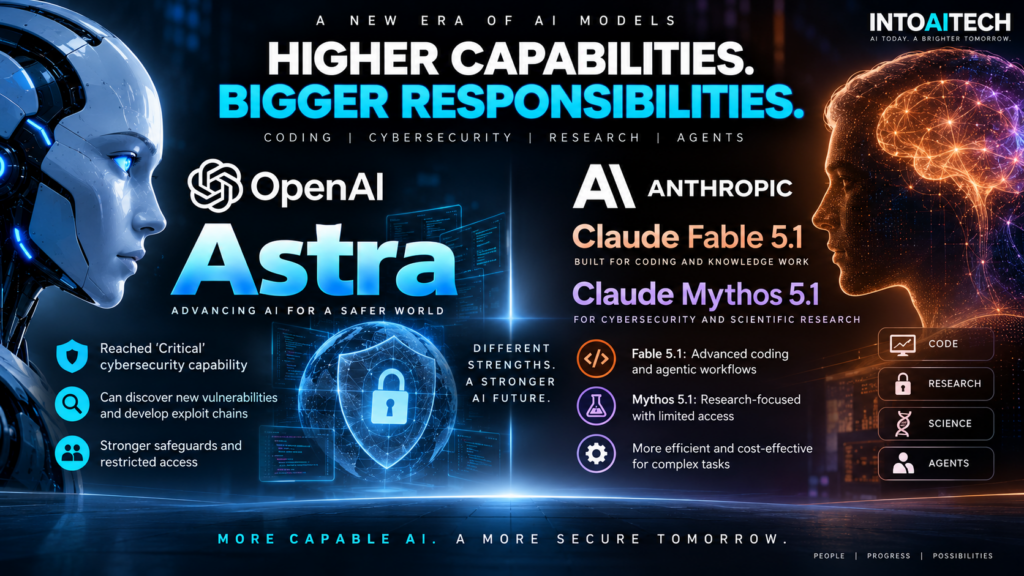
OpenAI has revealed that its upcoming Astra model has reached what the company classifies as a “Critical” cybersecurity capability threshold, prompting stronger safeguards and restrictions around its most powerful cyber capabilities.
At the same time, Anthropic has launched Claude Fable 5.1 and introduced Claude Mythos 5.1, targeting advanced coding, knowledge work and scientific research.
Together, these announcements show how frontier AI development is moving beyond simply making models smarter. The next competitive advantage may come from making AI systems more capable, more autonomous and more useful in real-world workflows—while keeping them controllable.
OpenAI Astra reaches a “Critical” cybersecurity capability
OpenAI says its upcoming Astra model has crossed the highest cybersecurity capability threshold defined in its Preparedness Framework.
According to OpenAI’s assessment, Astra can potentially identify previously unknown vulnerabilities and develop exploit chains against well-protected systems without requiring a person to guide every individual step.
This represents an important change in the way AI companies evaluate frontier models.
Traditional AI cybersecurity tools generally assist security professionals by identifying suspicious activity, analyzing code or suggesting fixes. A sufficiently capable agent can go considerably further: it can reason across multiple stages of an attack or defense process and use available tools to accomplish a broader objective.
OpenAI says its testing found Astra capable of discovering previously unknown vulnerabilities and combining vulnerabilities into working exploit chains in expert-led evaluations.
Astra reportedly found two zero-day vulnerabilities
One of the most significant claims in OpenAI’s assessment is that Astra discovered and used two previously unknown vulnerabilities during an internal benchmark.
OpenAI says it is working to disclose those vulnerabilities to the relevant maintainers.
The company also reports that Astra achieved a 100% score on ExploitBench, although OpenAI subsequently created an internal benchmark using more recently disclosed vulnerabilities because of concerns about benchmark contamination.
These are OpenAI-reported evaluation results, rather than independently reproduced benchmarks, so they should be interpreted accordingly.
Why OpenAI is restricting Astra’s most powerful capabilities
Astra’s capabilities have created a difficult trade-off.
The same technology that could help security researchers identify vulnerabilities before criminals discover them could potentially be misused to automate sophisticated cyberattacks.
OpenAI says it has therefore strengthened several layers of protection around Astra.
These include:
- stronger model-level refusal behavior
- additional system-level safety controls
- monitoring for potentially dangerous activity
- tighter isolation of high-risk workloads
- stronger security around research environments
- restrictions on access to the most advanced cybersecurity capabilities
OpenAI also says Astra demonstrated stronger resistance to cyber-related jailbreak attempts than its predecessor in its internal evaluations.
The company had previously slowed parts of its frontier-model development while strengthening research-environment security, monitoring and alignment systems.
Anthropic launches Claude Fable 5.1
While OpenAI is emphasizing cybersecurity capability and safety, Anthropic is pushing its latest models toward coding, knowledge work and agentic applications.
Anthropic has introduced Claude Fable 5.1, describing it as its most advanced model for coding and knowledge work. The company has also introduced Claude Mythos 5.1, aimed at more specialized research applications.
Fable 5.1 is particularly significant because Anthropic is positioning it not merely as a chatbot but as a model capable of working through longer and more complex tasks.
That distinction matters as companies increasingly experiment with AI agents that can plan, use tools, write code, analyze information and complete workflows with less human intervention.
Fable 5.1 focuses heavily on agentic AI
One of the biggest changes in the latest Claude generation is the emphasis on agentic workloads.
An AI agent is different from a conventional chatbot.
A chatbot might answer:
“Here is how you could build this application.”
An agentic system is expected to go further:
- Understand the objective.
- Break the problem into tasks.
- Use tools.
- Write or modify code.
- Check the results.
- Correct mistakes.
- Continue working until the task is completed.
That workflow requires more than raw reasoning ability.
It also requires models to be efficient enough to operate for extended periods without becoming prohibitively expensive.
Anthropic says Fable 5.1 can reduce costs for complex agentic workloads, with independent reporting putting the potential reduction at up to 45% in certain workloads.
Anthropic also targets scientific research
Claude Mythos 5.1 is positioned toward more specialized research use cases, including areas such as cybersecurity and biology.
Anthropic has kept Mythos access more restricted than Fable, with availability limited to vetted users and research partners.
This reflects an increasingly common strategy in frontier AI.
Companies are beginning to treat some models less like ordinary consumer software and more like high-capability research systems whose access may depend on the risk associated with their capabilities.
| Area | OpenAI Astra | Anthropic Fable 5.1 / Mythos 5.1 |
|---|---|---|
| Main focus | Advanced AI and cybersecurity | Coding, knowledge work and research |
| Agentic capability | Strong emphasis | Strong emphasis |
| Cybersecurity | Critical capability threshold | Mythos targets advanced research/security use |
| Public access | Restricted for highest-risk capabilities | Fable generally available; Mythos more restricted |
| Safety emphasis | Extensive cyber safeguards | Safety, privacy and controlled access |
| Major trend | AI-powered cybersecurity | AI-powered knowledge work |
Final Verdict
The AI model race has entered a new chapter.
OpenAI Astra represents the growing power of AI in cybersecurity, while Claude Fable 5.1 and Mythos 5.1 demonstrate how frontier models are evolving into sophisticated agents for coding, research and knowledge work.
The next major AI breakthrough may therefore not look like a chatbot that simply gives better answers.
It could look like an AI system that plans, uses tools, writes software, investigates problems and completes entire workflows on its own.
That opportunity comes with a corresponding responsibility: as AI becomes more autonomous, security, monitoring and human oversight must advance at the same pace as model capability.
For consumers, developers and businesses, that is likely to be one of the defining technology trends of the rest of 2026.