
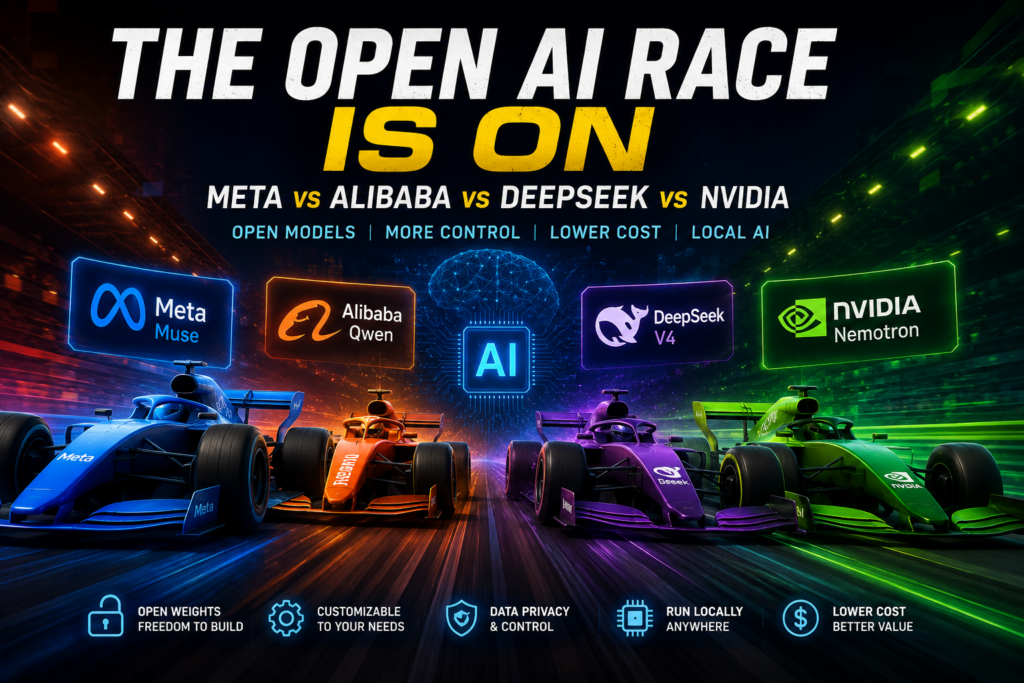
The Open-Weight AI Race Is Heating Up
The artificial intelligence industry is entering a new phase.
For the past few years, the biggest AI competition was largely about which company could build the most capable closed model.
Now another battle is becoming equally important:
Who can build the best AI model that developers can actually download, customize and deploy themselves?
That competition is known as the open-weight AI race, and it is accelerating rapidly.
Alibaba’s Qwen family has reportedly surpassed 3 billion global downloads, while Meta has returned aggressively to open-weight AI with its Muse models. DeepSeek is expanding its model lineup, and NVIDIA is building open models for agentic AI and enterprise applications.
What Is Open-Weight AI?
Before looking at the competition, it is important to understand the terminology.
An open-weight AI model makes its trained model parameters—the “weights” that determine how the model behaves—available for others to download and run, subject to the model’s license.
This can allow developers to:
- Run AI on their own infrastructure
- Fine-tune models
- Build specialized applications
- Deploy models locally
- Reduce dependence on a single API provider
- Keep sensitive data within their own environment
- Optimize models for particular hardware
However, open-weight does not necessarily mean fully open-source.
A company may release model weights without publishing all of its training data, training infrastructure or complete development process.
That distinction matters when evaluating AI models for commercial use.
Why Open-Weight AI Is Suddenly So Important
The economics of AI are changing.
Frontier AI models can require enormous amounts of computing power. Businesses using them through APIs can also face significant ongoing inference costs.
For many companies, however, they don’t need the absolute most powerful model for every task.
A smaller model that is:
- 90% as capable,
- considerably cheaper,
- customizable,
- deployable privately,
may be much more valuable for a particular business.
Alibaba’s Qwen Becomes a Major Open-Model Force
One of the biggest developments is coming from Alibaba.
The company’s Qwen family has reportedly surpassed 3 billion downloads globally over the past six months, according to figures reported from Alibaba and coverage citing Bloomberg. Alibaba says it has released more than 460 Qwen models, with hundreds of thousands of derivative models built around the ecosystem.
Meta Returns to the Open-Weight AI Battle
Meta is another major player pushing aggressively into this space.
On August 10, Meta introduced Muse Glimmer, a 30-billion-parameter open agentic model designed for local workflows.
Meta says Glimmer is optimized to run on a Mac or PC using a single consumer GPU and is designed for applications including local agents, function calling and coding.
This is strategically important.
The AI Race Is Moving From Chatbots to Agents
This could be the most important change in the open-model competition.
Traditional AI assistants primarily answer questions.
AI agents are designed to take actions.
Imagine an AI running locally on your computer that can:
- Read a folder of documents
- Summarize them
- Search for specific information
- Write a report
- Modify a spreadsheet
- Run code
- Check the results
- Correct errors
- Produce the final output
That is much closer to an autonomous software worker than a conventional chatbot.
Meta’s Muse strategy is explicitly focused on agentic workloads. NVIDIA is also positioning its open Nemotron models around agentic applications.
Why Businesses Are Interested in Open Models
For enterprises, AI isn’t simply about getting the highest benchmark score.
Companies care about:
Data control
Sensitive information may need to remain within a company’s infrastructure.
Customization
A business may want an AI model trained or fine-tuned for its own terminology and workflows.
Cost
Running a smaller model locally can sometimes be more economical than sending every request to a large cloud model.
Reliability
Companies may want greater control over their AI infrastructure instead of depending entirely on an external provider.
Data sovereignty
Organizations operating under regulatory or geographic restrictions may need AI systems deployed within particular jurisdictions.
NVIDIA specifically highlights customization, control and deployment where enterprise data resides as advantages of open models.
Final Verdict: The AI Race Is Changing
The open-weight AI race is no longer a side competition.
Alibaba’s Qwen ecosystem has reached enormous download numbers. Meta is putting capable agentic models onto consumer hardware. DeepSeek continues to demonstrate the importance of efficient AI, while NVIDIA is building an open-model ecosystem around enterprise agents and its computing platform.
The result is a fundamental shift in how AI is being built and deployed.
The question is no longer simply:
“Who has the smartest AI model?”
Increasingly, it is:
“Who can make powerful AI affordable, customizable, private and deployable anywhere?”
That competition could ultimately be more important to developers and businesses than the next benchmark record.
And for consumers, it could mean that the next generation of AI isn’t always running in a distant data center.
It may be running directly on the laptop, phone or device in front of you.