
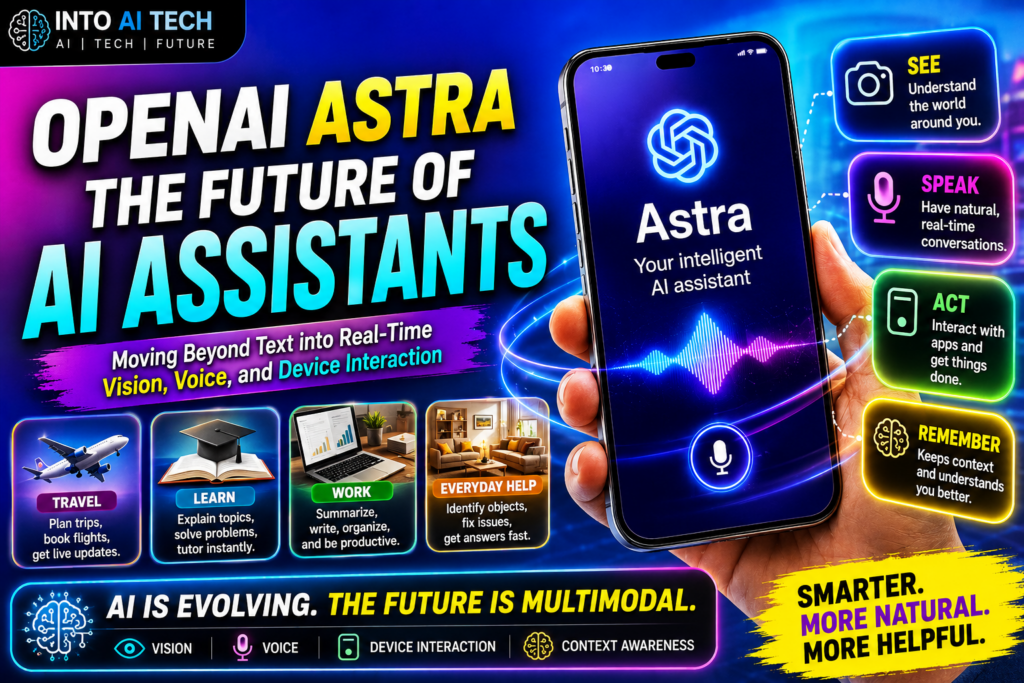
OpenAI Astra Continues to Shape the Future of AI Assistants
Artificial intelligence is rapidly evolving beyond traditional text-based chatbots. One of the biggest topics in the AI industry is OpenAI Astra, a project that showcases how future AI assistants could understand the world through vision, voice, memory, and real-time interaction instead of simply responding to text prompts.
While many AI assistants today can answer questions and generate content, the next generation aims to become intelligent companions that can see what you see, hear what you hear, and help you complete real-world tasks.
This shift marks one of the biggest changes in consumer AI since the introduction of large language models.
What Is OpenAI Astra?
OpenAI Astra is part of OpenAI’s broader vision for creating highly capable multimodal AI assistants.
Instead of limiting interactions to typed conversations, Astra is designed to understand multiple forms of information simultaneously, including:
- Text
- Voice
- Images
- Live video
- Device context
This enables AI to respond naturally while understanding both your conversation and the surrounding environment.
Imagine asking your AI assistant about an object while pointing your phone’s camera at it. Rather than describing the object manually, the assistant can recognize what it sees and provide relevant information instantly.
What Does “Multimodal AI” Mean?
Traditional AI systems work primarily with text.
Multimodal AI combines several types of information at once.
For example, an AI assistant can:
- Listen to your voice.
- Watch a live camera feed.
- Understand what’s displayed on your phone screen.
- Remember previous parts of the conversation.
- Respond naturally through speech.
This creates a much more human-like interaction.
From Chatbot to Digital Assistant
The first generation of AI mainly focused on answering questions.
The next generation focuses on completing tasks.
Instead of asking:
“What is the weather today?”
You might simply say:
“I’m visiting Goa next weekend. Help me plan everything.”
A future multimodal assistant could:
- Check weather forecasts.
- Compare flight prices.
- Recommend hotels.
- Build a travel itinerary.
- Add events to your calendar.
- Suggest restaurants.
- Estimate travel costs.
Rather than giving one answer, it helps complete an entire task.
Vision AI: Understanding the World Through Cameras
One of Astra’s most exciting capabilities is visual understanding.
Using a smartphone camera or wearable device, AI can identify:
- Buildings
- Plants
- Products
- Documents
- Computer screens
- Household objects
- Electrical appliances
For example, if your laptop displays an error message, simply pointing your camera at the screen could allow AI to explain the problem and suggest possible solutions.
This could reduce the need to manually search for technical help online.
Natural Voice Conversations
Typing isn’t always convenient.
Future AI assistants focus on continuous voice conversations that feel much closer to speaking with another person.
Instead of repeatedly issuing commands, users can ask follow-up questions naturally.
For example:
“What’s this monument?”
Then:
“When was it built?”
Followed by:
“Can I visit it today?”
The AI remembers the topic without requiring users to repeat the subject.
Device Interaction Changes Everything
Perhaps the biggest advancement is AI interacting directly with devices.
Instead of simply explaining how to perform an action, future assistants may help complete tasks across apps.
Possible examples include:
- Booking flights
- Drafting emails
- Organizing calendars
- Setting reminders
- Managing shopping lists
- Comparing product prices
This reduces the number of individual apps users need to open.
Why This Matters
The move from text-based AI to multimodal assistants represents a major shift in personal computing.
Instead of acting as a search engine replacement, AI becomes an intelligent layer that helps users navigate digital and real-world tasks more efficiently.
Potential benefits include:
- Faster access to information
- More natural conversations
- Better accessibility
- Improved productivity
- Smarter travel planning
- Easier learning experiences
- Context-aware assistance
- The Future of AI Assistants
- Over the next few years, AI assistants are expected to become increasingly proactive.
- Instead of waiting for commands, they may anticipate needs based on user preferences and context—for example, reminding you to leave early because of traffic or suggesting relevant information before a meeting.
- As multimodal technology matures, smartphones, smart glasses, vehicles, and other connected devices could work together with AI to create a more seamless digital experience.
Final Thoughts
OpenAI Astra highlights an important trend rather than a single product: the evolution of AI from a text-based chatbot into a multimodal assistant that can see, hear, understand context, and help users complete real-world tasks.
This transition has the potential to reshape how people interact with technology, making AI more intuitive, more useful, and more deeply integrated into daily life. While questions around privacy, accuracy, and responsible deployment remain, multimodal AI is poised to become one of the defining technologies of the coming years.