
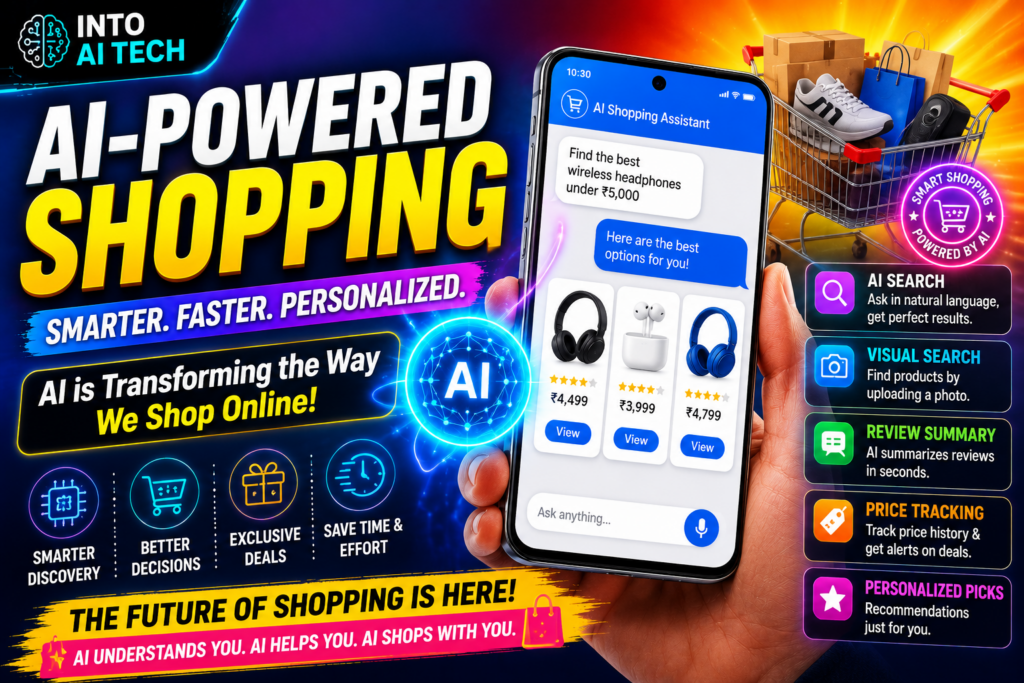
AI-Powered Shopping Is No Longer the Future—It’s Here
Artificial intelligence is rapidly transforming online shopping. Instead of spending hours comparing products, reading hundreds of reviews, and hunting for the best deals, shoppers can now rely on AI-powered assistants to simplify the entire buying journey.
The latest example comes from Amazon India’s Great Freedom Sale 2026, where AI features such as Rufus AI, Lens AI, Review Highlights, Buying Guides, and Price History tracking are becoming central to the shopping experience. These tools help customers discover products faster, compare options more effectively, and make confident purchasing decisions.
This marks a significant shift: e-commerce platforms are moving beyond traditional search bars toward intelligent shopping assistants that understand natural language, images, and personal preferences.
What Is AI-Powered Shopping?
AI-powered shopping uses artificial intelligence to help customers discover, compare, evaluate, and purchase products more efficiently.
Instead of manually filtering thousands of listings, shoppers can simply ask questions such as:
- “Suggest the best gaming laptop under ₹80,000.”
- “Find white sneakers similar to this photo.”
- “Notify me when this phone drops below ₹45,000.”
The AI analyzes your request, understands your intent, and recommends products that best match your needs.
AI Features Changing Online Shopping
1. AI Shopping Assistants
Modern AI assistants, such as Amazon’s Rufus, allow shoppers to search using everyday language instead of keywords.
For example, instead of searching:
“Wireless earbuds”
Users can ask:
“Recommend the best wireless earbuds under ₹3,000 with ANC.”
The AI understands the budget, desired feature, and product category before suggesting suitable options.
2. Visual Search
Typing isn’t always the easiest way to find a product.
With AI-powered visual search tools like Lens AI, users can upload or capture a photo, and the platform identifies similar products instantly.
This is particularly useful for:
- Fashion
- Furniture
- Home décor
- Electronics
- Accessories
Visual search removes the need to describe an item in words.
3. AI Review Summaries
Reading hundreds of customer reviews can be time-consuming.
AI now summarizes thousands of reviews into key insights, highlighting common strengths and weaknesses.
Instead of scrolling through pages of feedback, shoppers get a quick overview of:
- Product quality
- Battery life
- Camera performance
- Durability
- Comfort
- Value for money
This helps buyers make faster, more informed decisions.
4. Smart Price Tracking
One of the most practical AI features is price tracking.
AI monitors a product’s price history—often over the previous 30 to 90 days—and can alert users when it reaches a target price. This helps shoppers identify genuine discounts instead of relying solely on promotional labels.
Why AI-Powered Shopping Matters
The benefits extend beyond convenience.
Faster Product Discovery
AI reduces the time needed to find relevant products.
Better Purchase Decisions
Review summaries, buying guides, and comparisons help customers shop more confidently.
Improved Personalization
Recommendations become increasingly relevant as AI learns user preferences.
Time Savings
Natural-language search and visual search reduce repetitive browsing.
Better Deals
Price alerts and historical price tracking help buyers avoid overpaying.
The Future of Shopping
The future of e-commerce is likely to become increasingly conversational and multimodal.
Instead of typing product names, shoppers may simply:
- Show a photo.
- Describe what they need.
- Ask for the best deal.
- Let AI compare options.
- Receive personalized recommendations in seconds.
Final Verdict
AI-powered shopping is no longer a novelty—it’s becoming a core part of online retail.
Features like conversational search, visual product discovery, AI-generated review summaries, personalized recommendations, and intelligent price tracking are changing how consumers find and evaluate products. As these technologies continue to evolve, shopping will become faster, more personalized, and more efficient.
For consumers, this means less time searching and more confidence when buying. For retailers, it represents a new era where success depends not only on offering great products but also on making them discoverable through AI.