
Artificial Intelligence is no longer a futuristic concept reserved for research labs or cloud-based services. In 2026, AI has become a core part of everyday smartphone experiences. Whether you’re taking photos, translating conversations, organizing your schedule, editing videos, or protecting your personal data, AI is working silently in the background to make everything faster, smarter, and more personalized.
Today’s smartphones are no longer just communication devices. They are intelligent digital companions capable of understanding context, predicting user behavior, and performing complex tasks without requiring constant internet connectivity.
As competition among smartphone manufacturers continues to grow, AI has become one of the biggest factors separating flagship devices from older-generation phones. Companies like Samsung, Google, Apple, Xiaomi, OPPO, vivo, Honor, and Motorola are investing billions into AI-powered mobile experiences because they believe artificial intelligence represents the future of personal computing.
What Is an AI Smartphone?
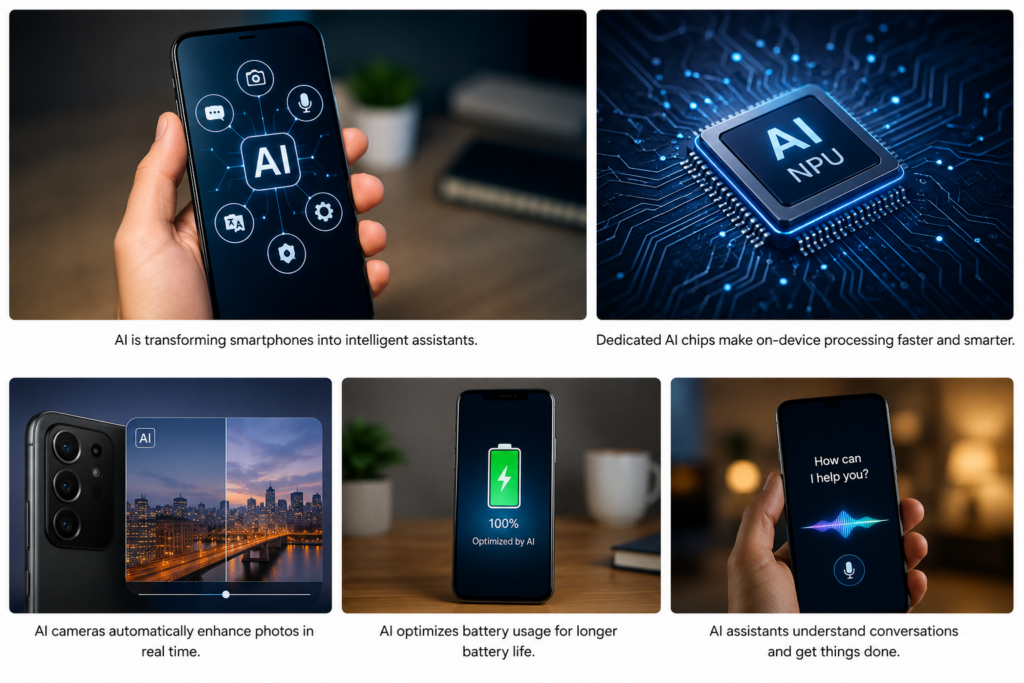
An AI smartphone is a mobile device that uses machine learning, neural processing units (NPUs), and advanced software algorithms to improve the overall user experience.
Unlike traditional smartphones that simply execute commands, AI smartphones can understand patterns, predict user needs, optimize performance, and automate everyday tasks.
Examples include:
- Intelligent photo enhancement
- Live language translation
- Voice assistants with natural conversations
- Automatic battery optimization
- Smart app suggestions
- AI-generated wallpapers
- Real-time transcription
- Writing assistance
- Document summarization
- AI-powered search
Instead of requiring users to manually configure settings, AI learns from daily usage and continuously improves over time.
Why AI Smartphones Are Growing So Fast
Several factors have accelerated AI adoption in smartphones.
1. Dedicated AI Chips
Modern processors include specialized Neural Processing Units (NPUs) designed specifically for AI workloads.
These chips process millions of AI calculations every second while consuming very little battery power.
Benefits include:
- Faster image processing
- Offline AI features
- Better voice recognition
- Lower power consumption
- Improved gaming performance
2. On-Device AI Is Replacing Cloud Processing
Earlier AI systems required sending data to cloud servers.
In 2026, many AI features run directly on the phone.
Advantages include:
- Faster responses
- Better privacy
- Lower internet usage
- Works offline
- Reduced latency
This represents one of the biggest technological shifts in modern smartphones.
3. AI Cameras Have Become Professional-Level
Photography remains one of the biggest reasons consumers upgrade smartphones.
Modern AI cameras automatically recognize scenes including:
- Food
- Pets
- Portraits
- Landscapes
- Night scenes
- Documents
- Fireworks
- Sports
- Sunsets
The AI instantly adjusts exposure, color balance, HDR, sharpness, focus, and noise reduction.
Users no longer need professional photography knowledge to capture high-quality images.
AI Makes Battery Life Smarter
Battery optimization is one of the most underrated AI features.
Instead of treating every app equally, AI learns:
- Which apps you use daily
- When you usually charge your phone
- Which apps drain battery
- Your sleep schedule
- Your travel habits
The phone intelligently limits background activity for unused apps while prioritizing frequently used applications.
This results in noticeably longer battery life.
AI Personal Assistants Are Finally Becoming Useful
Voice assistants have evolved dramatically.
Modern AI assistants can:
- Understand natural conversations
- Summarize long articles
- Draft emails
- Schedule meetings
- Search files
- Explain complex topics
- Translate conversations
- Answer follow-up questions
- Create shopping lists
- Plan trips
Instead of answering one command at a time, today’s assistants can complete multi-step tasks intelligently.
AI Improves Mobile Security
Cybersecurity threats continue to evolve.
AI now helps smartphones detect suspicious activity in real time.
Examples include:
- Fraud detection
- Spam call identification
- Malicious app detection
- Phishing protection
- Identity verification
- Facial recognition improvements
- Adaptive fingerprint recognition
This creates stronger protection without making the user experience more complicated.
Gaming Is Becoming Smarter with AI
AI isn’t only about productivity.
Gaming also benefits significantly.
AI can:
- Predict CPU usage
- Optimize graphics
- Stabilize frame rates
- Reduce overheating
- Improve touch response
- Lower battery drain during gaming
Competitive gamers benefit from smoother gameplay and more consistent performance.
AI Is Changing Mobile Productivity
Many professionals now use smartphones as portable workstations.
AI helps by:
- Summarizing meetings
- Converting speech to text
- Rewriting documents
- Translating PDFs
- Creating presentations
- Organizing notes
- Generating email replies
- Managing calendars
These capabilities reduce repetitive work and improve productivity.
AI Makes Smartphones More Accessible
Accessibility has improved dramatically through AI.
Useful features include:
- Live captions
- Real-time translation
- Object recognition
- Voice control
- Reading assistance
- Visual descriptions
- Hearing assistance
- Smart magnification
These innovations help make smartphones easier to use for people with different needs.
Challenges of AI Smartphones
Despite rapid progress, AI smartphones still face important challenges.
Privacy
Users want assurance that personal information remains secure when AI processes sensitive data.
Battery Consumption
Advanced AI features require efficient hardware to avoid excessive battery drain.
Cost
Premium AI hardware increases manufacturing costs, making flagship smartphones more expensive.
User Trust
AI-generated information can occasionally be inaccurate, so users should verify important details before relying on them.
What the Future Looks Like
Over the next few years, smartphones are expected to become even more intelligent.
Future developments may include:
- Fully personalized AI assistants
- Real-time multilingual conversations
- AI-generated videos
- Advanced health monitoring
- Context-aware recommendations
- Improved augmented reality experiences
- Smarter wearable integration
- More powerful offline AI
Rather than simply responding to commands, future smartphones will proactively help users accomplish everyday tasks.
Should You Buy an AI Smartphone in 2026?
If you’re planning to upgrade your phone, choosing an AI-enabled smartphone is becoming less of a luxury and more of a practical investment.
Modern AI features save time, improve photography, enhance security, extend battery life, and simplify everyday tasks. As software developers continue building AI-first applications, smartphones without dedicated AI capabilities may begin to feel outdated much sooner than previous generations.
Whether you’re a student, content creator, gamer, business professional, or casual user, AI-powered smartphones offer meaningful improvements that go beyond marketing buzzwords.
Frequently Asked Questions
What is an AI smartphone?
An AI smartphone uses artificial intelligence and dedicated hardware to improve photography, battery life, security, productivity, and user experience.
Does AI work without the internet?
Many modern AI features run directly on the device, allowing certain capabilities to function offline.
Are AI smartphones safer?
AI enhances security through spam detection, fraud prevention, biometric improvements, and smarter privacy protections, but users should still follow good security practices.
Is it worth upgrading to an AI smartphone?
If your current device lacks modern AI capabilities and you value better performance, photography, and productivity, upgrading can provide noticeable benefits.
Final Thoughts
Artificial intelligence is transforming smartphones from powerful gadgets into intelligent companions that understand user behavior and adapt to individual needs. In 2026, AI is no longer an optional feature reserved for premium devices—it is becoming the foundation of the next generation of mobile technology.
As AI hardware and software continue to evolve, the distinction between a “smartphone” and an “AI smartphone” will gradually disappear. The devices we carry every day will become increasingly capable of helping us work, learn, create, communicate, and solve problems with greater speed and convenience.
For consumers, the question is no longer whether AI belongs in smartphones. The real question is how quickly these intelligent capabilities will reshape our digital livWhy AI Smartphones Are Becoming the New Standard in 2026
Artificial Intelligence is no longer a futuristic concept reserved for research labs or cloud-based services. In 2026, AI has become a core part of everyday smartphone experiences. Whether you’re taking photos, translating conversations, organizing your schedule, editing videos, or protecting your personal data, AI is working silently in the background to make everything faster, smarter, and more personalized.
Today’s smartphones are no longer just communication devices. They are intelligent digital companions capable of understanding context, predicting user behavior, and performing complex tasks without requiring constant internet connectivity.
As competition among smartphone manufacturers continues to grow, AI has become one of the biggest factors separating flagship devices from older-generation phones. Companies like Samsung, Google, Apple, Xiaomi, OPPO, vivo, Honor, and Motorola are investing billions into AI-powered mobile experiences because they believe artificial intelligence represents the future of personal computing.