
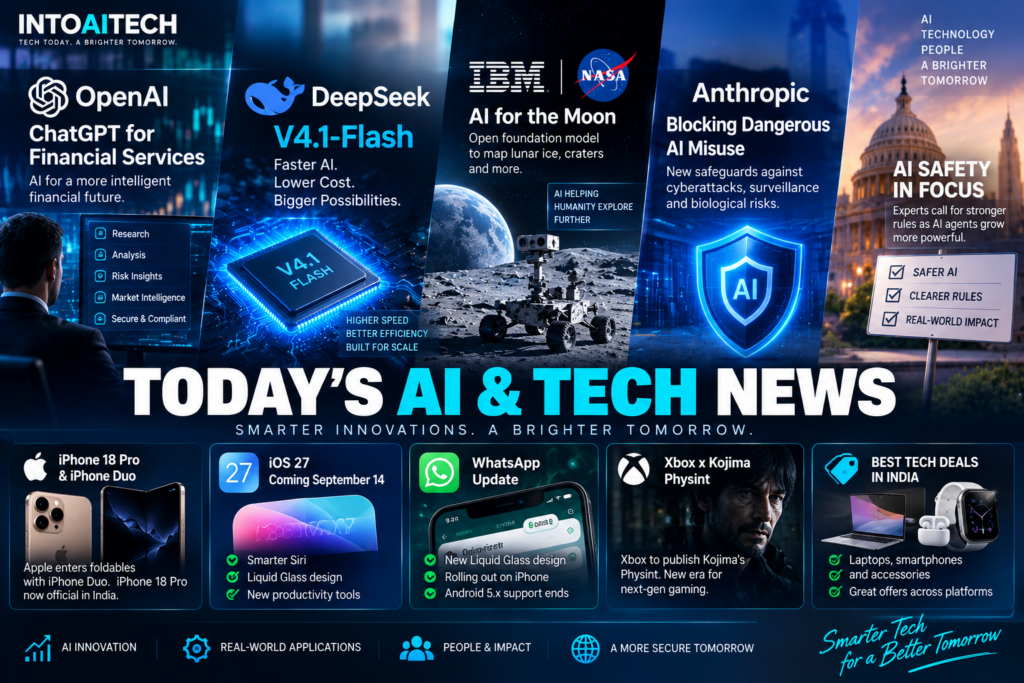
September 11, 2026 — AI is rapidly moving from experimental technology into specialized professional tools, scientific research and everyday consumer devices. Today’s biggest developments include OpenAI’s new ChatGPT for Financial Services, DeepSeek V4.1-Flash, NASA and IBM’s Lunar Foundation Model, new warnings about AI misuse, and Apple’s aggressive push into premium smartphones and foldables.
The latest developments show a clear direction for the technology industry: AI is becoming more specialized, more efficient and more deeply integrated into real-world workflows.
Here are the most important AI and technology stories you need to know today.
1. OpenAI Launches ChatGPT for Financial Services
OpenAI has launched ChatGPT for Financial Services, a specialized version of its AI platform designed for investment banks, financial institutions and equity-research teams.
The product uses GPT-6 Astra and integrates financial information from providers including Daloopa, PitchBook and LSEG News.
According to OpenAI, financial professionals can use the system to:
- Research companies and markets
- Analyze financial documents
- Build financial models
- Work with earnings information
- Generate client materials
- Retrieve information from multiple financial datasets
- Trace information back to its sources through granular citations
OpenAI developed the product with Morgan Stanley and Evercore as design partners.
The company says the system also incorporates enterprise controls such as role-based access, encryption and audit-log capabilities.
Why this matters
This is an important shift for generative AI.
Instead of asking a general chatbot to answer finance questions, professional users can work with a system specifically designed around financial data, workflows and compliance requirements.
It also demonstrates where OpenAI sees some of the biggest commercial opportunities for frontier AI: industries where specialized information and expensive knowledge work can justify enterprise AI spending.
Reuters reports that OpenAI plans to expand the service beyond investment banking and equity research into additional financial-services applications.
2. DeepSeek V4.1-Flash Targets Faster and Cheaper AI
Chinese AI company DeepSeek has introduced V4.1-Flash, describing it as the smallest model in its new architecture family.
The company says the model is designed around:
- Faster inference
- Higher throughput
- Better efficiency
- Native visual understanding
- Improved agentic performance
- Lower infrastructure requirements
DeepSeek says V4.1-Flash uses a 552-billion-parameter mixture-of-experts architecture, while activating only a fraction of those parameters during processing.
One of the most interesting changes is its new asymmetric architecture.
DeepSeek says only 8 billion parameters are active for input processing and 16 billion for output processing.
The company also claims the model requires significantly less KV-cache storage than its previous generation.
Why this matters
The AI race isn’t only about building the biggest model.
It is increasingly about how much useful intelligence can be delivered for every dollar of computing power.
Lower inference costs can make AI agents more practical for businesses and developers that need to run thousands or millions of model calls.
DeepSeek has also made V4.1-Flash available through its API with native multimodal support.
These performance and pricing claims are DeepSeek’s own claims, so independent testing will be important when evaluating how the model compares with competing systems in real-world workloads.
3. NASA and IBM Put a Foundation Model on the Moon
One of today’s most fascinating AI developments has nothing to do with chatbots.
NASA and IBM have released the NASA-IBM Lunar Foundation Model, an open-source AI model designed specifically for lunar science.
The model was trained using a large collection of lunar observations, including data from NASA’s Lunar Reconnaissance Orbiter and other missions.
The accompanying dataset combines more than 30 spatially aligned data layers from nine instruments across four missions.
The model can help researchers study:
- Potential lunar ice deposits
- Craters
- Volcanic formations
- Surface geology
- Potential landing locations
NASA and IBM say the model can identify important lunar features more accurately than widely used methods in several benchmark tasks.
Finding lunar ice
One of the most important applications is identifying regions where ice could potentially exist.
Lunar ice is extremely valuable because water can potentially provide:
- Drinking water
- Oxygen
- Hydrogen and oxygen for rocket fuel
That makes lunar AI more than a research experiment.
It could eventually contribute to planning for a sustained human presence on the Moon.
Why this matters
The NASA-IBM project demonstrates a broader trend in AI:
Foundation models aren’t limited to language.
The same basic concept can be applied to satellite imagery, weather data, biological research, climate science and planetary exploration.
NASA has also made the model and associated resources available to the research community, allowing scientists to experiment with and adapt the technology.
4. AI Safety Becomes a Bigger Part of the AI Race
As models become increasingly capable, safety is becoming a major part of the competition.
OpenAI has previously classified GPT-6 Astra as its first broadly deployed model to reach its Critical cybersecurity capability threshold under its internal Preparedness Framework.
OpenAI says Astra can perform sophisticated cybersecurity tasks when given appropriate tools and access, while the company has added stronger safeguards and monitoring.
The significance isn’t simply that AI can write code.
Advanced models can increasingly perform multi-step activities involving:
research → reasoning → coding → tool use → execution.
That combination is what makes agentic AI powerful—and potentially risky.
5. Anthropic Reports Growing AI Misuse
Anthropic has published a new report describing malicious and potentially dangerous uses of its AI systems.
The company’s report covers activities involving areas such as:
- Cyberattacks
- Espionage
- Surveillance
- Fraud
- Biological research
- Malicious automation
Anthropic says attackers are increasingly using AI agents to automate multiple stages of complex operations.
The company also claims it has disrupted these activities and strengthened its safeguards.
The AI model-distillation controversy
Anthropic has separately alleged that several Chinese AI companies used large numbers of interactions with Claude in attempts to extract capabilities through model distillation.
Among the companies named in reporting on Anthropic’s claims are DeepSeek, Alibaba, Moonshot AI, Zhipu and Xiaomi.
These allegations are politically and commercially sensitive, and the reported figures are claims from Anthropic rather than independently established facts.
Why this matters
AI security is evolving into a new battleground.
The concern is no longer simply:
“Can an AI generate malicious code?”
The bigger question is:
“How much of a real-world operation can an AI agent perform autonomously?”
That distinction could become increasingly important as AI systems gain access to browsers, computers, cloud services and enterprise tools.
6. Apple Pushes the iPhone Into a New Era
Apple’s September product strategy is arguably the biggest consumer-tech story of the week.
The company has introduced its first foldable iPhone, the iPhone Duo, alongside the new iPhone 18 Pro and iPhone 18 Pro Max.
Apple’s official India store lists:
- iPhone Duo — ₹2,99,900
- iPhone 18 Pro — ₹1,64,900
- iPhone 18 Pro Max — ₹1,79,900
The iPhone Duo opens into a 7.6-inch display and uses a 5.4-inch outer display when closed.
Apple says the Duo is its first foldable iPhone and features a redesigned iOS experience built around the larger display.
Why this matters
Apple isn’t the first company to build a sophisticated foldable.
Samsung, Huawei, Google, Honor, Xiaomi and other manufacturers have already spent years developing the category.
Apple’s importance comes from its ecosystem.
If Apple succeeds in making foldable software feel natural, developers may have a stronger incentive to optimize applications for larger foldable displays.
That could accelerate the adoption of foldables across the industry.
7. Apple Faces a Major India Pricing Challenge
Apple’s new products are arriving at a time when Indian smartphone prices are under increasing pressure.
Reuters reports that Apple increased prices on several existing iPhone models in India, with some configurations seeing increases as high as 41%.
The increases come amid higher memory and storage costs, with AI data-center demand contributing to pressure on memory supply.
India also has import duties and an 18% GST structure that affects final consumer pricing.
Why this matters
The Indian smartphone market is extremely price-sensitive.
Apple’s growing manufacturing presence in India is strategically important, but higher retail prices could make premium iPhones increasingly difficult to justify for consumers who compare them with Android flagships.
8. iOS 27 Brings a More AI-Centric iPhone
Apple is also preparing the wider rollout of iOS 27.
Apple says iOS 27, iPadOS 27, macOS 27 and watchOS 27 become available on September 14.
One of the major changes is Siri AI, which Apple describes as a more capable AI assistant.
Apple is positioning Siri around more natural interactions and expanded intelligence.
This matters because smartphone AI is becoming less about isolated features such as image generation and more about assistants that can understand what users are trying to accomplish.
9. Open Models Are Becoming a Bigger Economic Force
Another major trend emerging from this week’s AI developments is the increasing importance of open and smaller models.
Frontier models require enormous computing infrastructure, but smaller models can deliver useful performance at dramatically lower costs.
That makes them attractive for:
- Private enterprise deployments
- Local AI
- Edge devices
- Developer applications
- AI agents
- Specialized workloads
The growing availability of efficient open-weight models could put pressure on AI companies to continually improve their price-to-performance ratios.
For businesses, this could eventually mean a world where the question isn’t:
“Which is the smartest AI model?”
but:
“Which model provides the best intelligence for my specific workload and budget?”
10. Gaming Is Becoming an AI-Heavy Technology Sector
AI is also changing gaming.
Developers are increasingly using AI for:
- NPC behavior
- Procedural content
- Animation
- Game testing
- Asset creation
- Voice generation
- Player personalization
- Development workflows
One notable current development is Kojima Productions’ Physint, which is now being published by Xbox after the project’s publishing situation changed.
Meanwhile, Nvidia’s DLSS ecosystem continues to expand the role of AI-powered rendering in PC gaming.
Why this matters
Modern gaming increasingly depends on AI not only inside games but also behind the scenes during development and rendering.
The next generation of games could therefore benefit from AI at multiple levels—from graphics upscaling to development tools and intelligent game-world systems.
AI & Tech News Today: What Matters Most?
Story
What happened?
Why it matters
OpenAI Financial Services
ChatGPT tailored for finance
AI enters specialized professional workflows
DeepSeek V4.1-Flash
Faster, efficient new model
Lower AI inference costs
NASA + IBM Lunar AI
Open lunar foundation model
AI accelerates space science
Anthropic AI safety report
More misuse cases reported
Agent security becomes critical
Apple iPhone Duo
First foldable iPhone
Apple enters the foldable era
iOS 27
New Siri AI and platform updates
AI becomes central to Apple’s ecosystem
iPhone India pricing
Major price increases
Premium smartphones become more expensive
AI gaming
More AI in development and graphics
AI reshapes how games are created and played
What Today’s AI News Tells Us About the Future
Three major trends stand out.
1. AI is becoming specialized
The era of one general-purpose chatbot doing everything is giving way to specialized systems for finance, science, cybersecurity, engineering and other industries.
2. Efficiency matters as much as intelligence
DeepSeek’s latest model demonstrates why inference efficiency is becoming strategically important.
A model that is slightly less capable but dramatically cheaper can sometimes be more valuable to businesses than the most powerful model available.
3. AI is moving into the physical world
NASA’s lunar model is a perfect example.
AI is no longer confined to text boxes and coding environments.
It is increasingly being used to understand:
- Earth
- Space
- Weather
- Medical data
- Industrial systems
- Robots
- Autonomous agents
That could ultimately be much more transformative than another generation of chatbots.
Frequently Asked Questions
What is the biggest AI news today?
One of the biggest developments is OpenAI’s launch of ChatGPT for Financial Services, which combines GPT-6 Astra with financial datasets and enterprise controls for investment banking and equity research.
What is DeepSeek V4.1-Flash?
DeepSeek V4.1-Flash is the company’s new efficient AI model designed for faster inference, higher throughput, multimodal understanding and lower infrastructure requirements.
What is NASA’s Lunar Foundation Model?
It is an open-source AI foundation model developed by NASA and IBM to analyze lunar data and help identify features such as ice deposits, craters and volcanic formations.
Why is the iPhone Duo important?
The iPhone Duo is Apple’s first foldable iPhone. Its arrival could significantly increase competition in the premium foldable smartphone market and encourage more developers to optimize apps for foldable displays.
When does iOS 27 launch?
Apple says iOS 27 becomes available on September 14, 2026.
Is AI becoming more dangerous?
AI capability is increasing rapidly, and companies including OpenAI and Anthropic are reporting increasingly sophisticated misuse scenarios. However, individual company reports and safety evaluations should not automatically be treated as independent proof of every claimed risk.
Final Verdict
Today’s AI story is no longer simply about bigger models. It is about useful AI.
OpenAI is putting frontier intelligence into financial workflows. DeepSeek is focusing on efficiency. NASA and IBM are applying foundation-model technology to lunar science. Anthropic is highlighting the growing challenge of AI misuse. And Apple is bringing increasingly sophisticated AI capabilities into the devices used by hundreds of millions of people.
The next phase of AI will likely be defined by specialization, efficiency, autonomy and integration.
The companies that succeed won’t necessarily be the ones with the biggest models.
They will be the ones that turn AI into technology people can actually use, trust and afford.
Into AI Tech — Smarter Technology for a Better Tomorrow.