
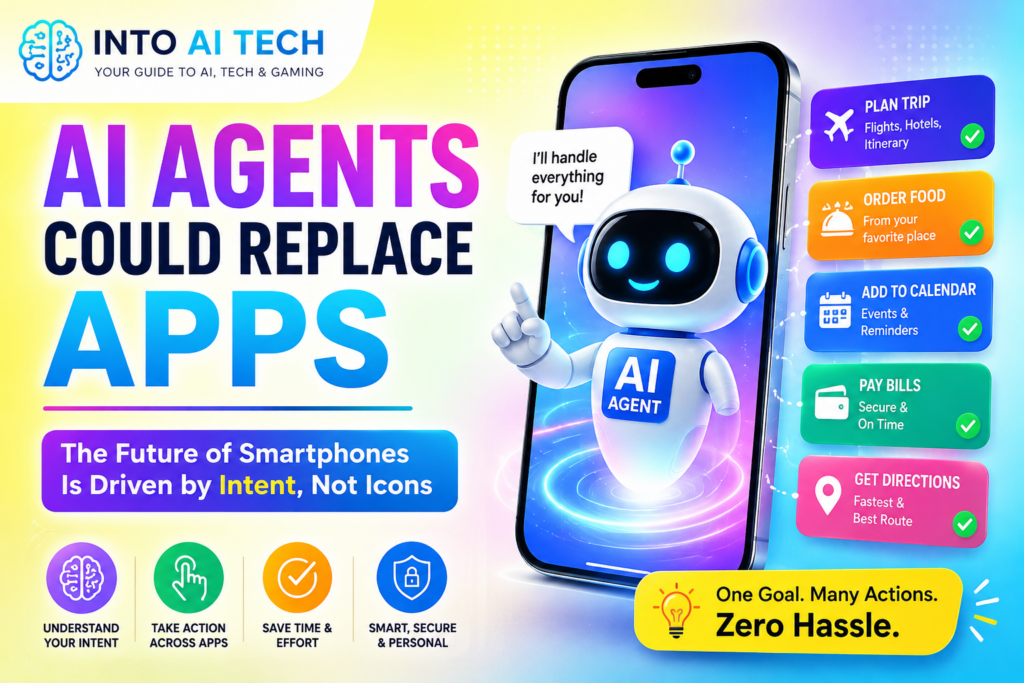
AI Agents Could Replace Apps: The Biggest Smartphone Revolution Since Touchscreens
For nearly two decades, smartphones have revolved around one simple idea: open an app, complete a task, then switch to another app. Whether ordering food, booking a cab, editing photos, or sending money, users have become accustomed to navigating through dozens—or even hundreds—of apps.
That familiar experience may soon become obsolete.
A new generation of AI agents is emerging, promising to transform smartphones from collections of apps into intelligent assistants capable of understanding what users want and completing tasks across multiple services automatically. Instead of tapping icons, users may simply describe their goal, while AI coordinates everything in the background.
The shift could represent the most significant change in mobile computing since the introduction of the touchscreen smartphone.
Real-World Example
Real-World Experience
| Scenario | Using Mobile Apps | Using an AI Agent |
|---|---|---|
| Book a Vacation | Open travel app → Compare flights → Book hotel → Check weather → Open Maps → Add events to Calendar | “Plan a 3-day Goa trip under ₹30,000 next month.” AI finds flights, books hotels, suggests attractions, checks weather, and adds the itinerary to your calendar. |
| Food Delivery | Open Swiggy/Zomato → Search → Compare → Order | “Order a vegetarian dinner under ₹500 from my favorite restaurant.” |
| Meeting Preparation | Open Email → Calendar → Notes → Docs | “Summarize today’s emails, prepare meeting notes, and schedule follow-ups.” |
| Online Shopping | Visit multiple shopping apps to compare prices | “Find the best price for a Galaxy S26 Ultra with bank offers.” |
Challenges Ahead
Despite their potential, AI agents still face important challenges.
Privacy
AI agents may require access to emails, calendars, contacts, documents, and financial information.
Users will expect clear permissions, transparency, and strong security protections.
Trust
People may hesitate to let AI complete purchases or manage important tasks without reviewing every step.
Building trust will require reliable performance and user control.
Compatibility
AI agents must work across apps and platforms.
Developers and operating system providers will need common standards that allow AI to interact with third-party services securely.
Accuracy
Incorrect bookings, misunderstood requests, or inaccurate recommendations could reduce confidence in AI agents.
Continuous improvements in reasoning and reliability will be essential.
Will Apps Disappear Completely?
Probably not.
Apps will continue to provide the underlying services that power digital experiences.
However, they may become less visible to users.
Instead of opening individual apps, people could interact with one AI interface that coordinates multiple applications behind the scenes.
Apps become infrastructure.
AI becomes the interface.
How Claude Focusing Indian User : Read Here
What This Means for Developers
The rise of AI agents could reshape software development.
Developers may increasingly design applications that expose secure APIs for AI systems rather than relying solely on traditional user interfaces.
Future app development could focus on:
- AI compatibility
- Structured data
- Workflow automation
- Natural language interactions
- Intelligent recommendations
This transition could create new opportunities while changing how software is designed and monetized.
Google NotebookLM Guide : Read Here
Final Thoughts
Artificial intelligence is steadily moving from being a feature inside apps to becoming the primary interface through which users interact with technology. AI agents have the potential to simplify everyday tasks, reduce digital friction, and transform smartphones into proactive assistants that understand context, intent, and personal preferences.
While challenges such as privacy, trust, and interoperability remain, the momentum behind AI-powered mobile experiences continues to grow. As hardware becomes more powerful and AI models become more capable, the shift from tapping app icons to simply expressing intent may become one of the defining technology trends of the next decade.